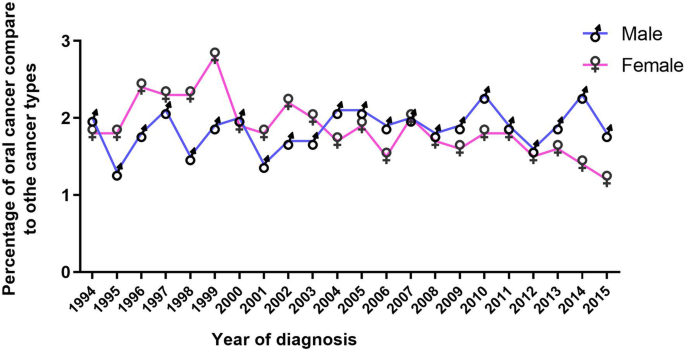
Trends in the incidence of oral cancer in Saudi Arabia from 1994 to 2015
Increase in the number of oral cancer cases
The total number of cancer cases identified by the SCR from 1994 to 2015 was 172,424, with 83,185 (48.2%) males and 89,239 (51.7%) females. Of this total, 3184 cases (1.8%) were oral cancer. The number of registered oral cancer cases increased gradually from 109 (63/46 M/F) in 1994 to a peak of 211 (121/90 M/F) in 2014; however, only 175 cases were reported in 2015 (96/79 M/F) (Table 1).
The percentage of cases representing oral cancers was 1.8% for females and 2.0% for males (Fig. 1) in 1994. These percentages decreased to 1.6% for females and 1.9% for males in 2015 (Fig. 1). The percentage curve for oral cancer out of all cancer types for males and females correlated with increases and decreases over the study period, apart from the years 1998 and 1999 (Fig. 1).

Consistency in percentage curves for oral cancer out of all cancer types from 1994 to 2015. The percentage curve for oral cancer out of all cancer types for males and females are correlated with overall increases and decreases over the period from 1994 to 2015, with the exception of years 1998 and 1999
ASR of oral cancer fluctuated over the study period
Between 1994 and 2015, the ASR per 100,000 male cases fluctuated: in 1994, it was 1.8, trending downwards to a low of 0.6 in 2001 and peaking at 2.0 in 2010 before dropping again to 1.4 in 2015 (Fig. 2). The female ASR per 100,000 increased from 1.6 in 1994 to a peak of 2.3 in 1999, decreasing again to 1.1 in 2015 (Fig. 2). For both sexes, ASR curves, like oral cancer percentages, correlate to increases and decreases over the study period (apart from the years 1998, 1999 and 2009) (Fig. 2) and generally remained constant from 1994 to 2015.

Age-standardised incidence rates (ASR) of oral cancer fluctuated over the study period. Between 1994 and 2015, the male ASR was 1.8 per 100,000 in 1994 and dropped to 0.6 in 2001. The female ASR fluctuated between 1.1 and 2.3 per 100,000
AIR of oral cancer increases with age
The AIR data from 1994 to 2015 showed a positive correlation between oral cancer incidence and age, with most cancer cases occurring in the older age groups. Figure 3 shows the AIR of oral cancer increasing noticeably with age up until age 75. More than 75% of cases were diagnosed after the age of 50.

Age-specific incidence rates (AIR) of oral cancer increases with age. The total AIR of oral cancer increased noticeably with up until patients were 75 and over. More than 75% of the cases were diagnosed after the age of 50
Some AIR differences were found between the sexes across age groups. From ages 35 to 64, rates of oral cancer were higher in females than in males; however, this trend had reversed to favour males in the 75-and-over age group. The overall AIR per 100,000 showed only slight differences between the sexes, at 33.6 for females and 31.2 for males (Fig. 3).
ASR of oral cancer varies by region
The ASR data for oral cancer cases of all persons demonstrated a wide variation across Saudi regions. The ASR means per 100,000 people for the period from 1994 to 2015 ranged from 1.5 in Hail to 19.6 in Jazan, with a national average of 4.8 per 100,000 (Fig. 4).

Age-standardised incidence rates (ASR) of oral cancer varies by region in Saudi Arabia. For all persons, the ASR means per 100,000 people for the period from 1994 to 2015 ranged from 1.5 in the Hail region to 19.6 in the Jazan region
The Jazan region had the highest male ASR mean at 6.9, followed by the Najran and Tabuk regions at 3.1 each (Fig. 4). Conversely, Qassim, Baha, Hail and the Northern province reported the lowest ASR averages at 1.0, 1.1, 1.1 and 1.2 per 100,000, respectively (Fig. 4).
Male and female ASR data were generally equivalent in terms of region rankings, with the Jazan region posting the highest overall ASR of 12.7 as an average value of both genders, followed by the Makkah region at 2.9 and the Najran region at 2.3 (Fig. 4). Similarly, the Hail, Baha, Qassim and Madinah regions posted the lowest ASR averages at 0.3, 0.9, 1.1 and 1.3, respectively (Fig. 4).
Published at Thu, 20 Aug 2020 21:07:10 +0000