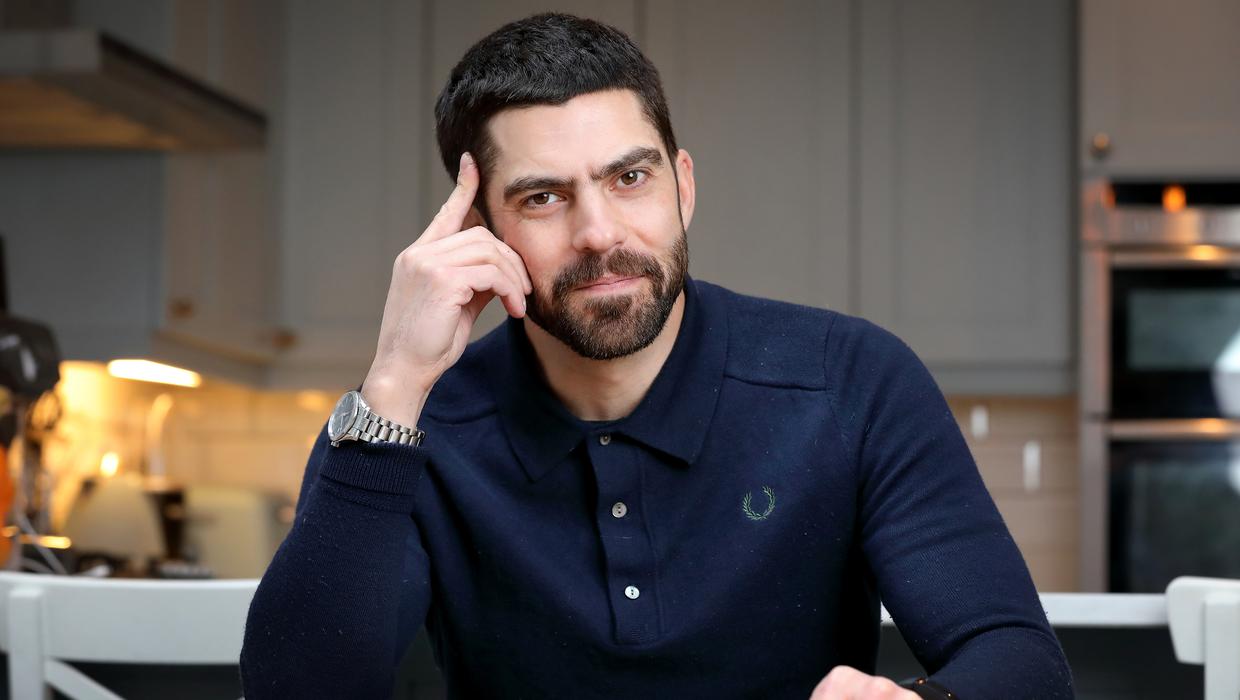
Lung cancer is Ireland’s biggest cancer killer, despite being largely preventable and treatable. The problem is, this is often diagnosed at a late stage, partly because people find it difficult to distinguish a cough that indicates something serious — a particular worry this year is that symptoms such as a persistent cough may be hiding behind Covid-19 and flu — but also because too many people are reluctant to see their GP, for fear of wasting their time.
his is exactly what held James Heriot (42) back, when he first began to notice a steady decrease in his physical health in late-2016. “Hindsight is a wonderful thing,” he says ruefully. “Looking back, I can’t believe how reluctant I was to go to the doctor, for fear of wasting his time.”
At the time, Heriot was 38. “I have always been fairly fit and fairly healthy,” he says. “I did a fair amount of exercise, I went to the gym regularly and played football regularly. I’d always had quite bad hay fever, and I’d gone to my doctor in the summer of 2016 because I’d noticed that when playing football — which I did once a week — I was getting more wheezy and chesty. He said that as part of having hay fever, you can end up developing adult asthma.” That’s what it seemed to be. James began using a Ventolin inhaler, which, he says, “did help. It relieved the symptoms.”
However, once his daughter, then five, started school that September, James began to notice, “that I was picking up coughs and colds, which I wouldn’t normally have done. I put it down to getting older and decided that it’s just one of those things. I made sense of it all in my head.”
Come Christmas of that year, and he got a flu he couldn’t shake as quickly as he generally would. “Normally, if I got sick, I’d spend a day in bed and sleep it off. I would get over things fairly quickly, but I noticed things were starting to linger. I had an ongoing cough, I was feeling chesty, and it was starting to impact on things like my football. I remember feeling annoyed that I couldn’t shake these things. Looking back, the signs were there but I didn’t do anything about it.”
In the new year, “I had a night where I started coughing up blood,” he says. “That should have been the sign, but being a pig-headed, ignorant man, it wasn’t.” Even though he spent “a really bad night; I went into a very bad place with Doctor Google,” during which he saw lung cancer returned as a possible diagnosis, “I dismissed it. I started looking at the more optimistic things — a bad chest infection — and I sat on it for another month, maybe five weeks. It kept happening — the coughing up blood — and I didn’t do anything about it, and I didn’t tell anyone about it. If I had, my wife would have made me go straight to the GP.”
Finally, after a weekend in Scotland with friends, for an Ireland-Scotland rugby game, “it came to a head,” James says. “I came back from that and was completely kyboshed. So finally I decided, right, I’m going to do something about this…”
His GP referred him immediately to a chest specialist in St Vincent’s Hospital, who was, James says, “fairly relaxed. He said ‘you’re young, you don’t smoke, there’s probably nothing to worry about, but we’ll check it out properly.’” X-rays were done, and on Valentine’s Day 2017, James got a phone call to say there was a shadow on his lungs. “Even then, I was being told it might well be lymphoma, which is very treatable.” However, the results of further tests revealed it was in fact lung cancer. “The world fell apart a bit,” he says. “I went into a bubble, my wife was there with me, and I just froze, I went numb. By then it was stage three — much more serious than it would have been if I’d caught it earlier.”
That said, he was, he insists, “very lucky. I was referred to an incredible oncologist, a treatment plan was put together, and I started on a regime of radiotherapy and chemotherapy, both at the same time, because I was young, and they decided I could take it.”
James’ cancer is caused by a genetic mutation. “Weirdly,” he says, “I have an uncle based in the States, who is involved in funding for cancer research, who knows the scientist who discovered the mutation. He was firing information at me as well, so I knew I was getting the best treatment.”
James did three months of daily radiotherapy, and seven cycles of chemo, involving two different drugs. “I did pretty well on that,” he says. “There were no huge physical inconveniences. I was able to tolerate both relatively well, and I was able to work pretty much all the way through. That helped; still feeling part of society, having a small element of control still in your life, was very helpful for me.”
In October of 2017, all the indications where that the chemo and radio had worked, and the cancer was gone. However, follow-up scans in February 2018 revealed that it had metastasized and had reached the brain. “That was the big fear, and unfortunately, it happened,” James says. “I think the first time around, it had all been such a whirlwind, everything happened so fast, that it was hard to take in. It didn’t really hit me. I didn’t worry about the hows/ whys/ wherefores — I concentrated on doing what I was told: do the treatment, keep strong, get through it. The second diagnosis was the one that really threw me. That was the lowest moment.”
But again, he believes he was lucky. “I was referred to an amazing radiotherapist and he decided that to use stereotactic radiotherapy, this is a really targeted radiotherapy that can almost be described as surgery, because it only affects the tumour itself, and the blood vessels that allow the tumour to grow, minimising the impact on the rest of the brain, which is obviously the goal.” (This stereotactic radiotherapy [SRT] gives radiotherapy from many different angles around the body. The beams meet at the tumour. This means the tumour receives a high dose of radiation and the tissues around it receive a much lower dose.)
“I responded really well to that,” James says, “It worked. I was also put on a targeted therapy treatment, which means I take drugs every day — but this is very un-invasive, nowhere near as bad as chemo. It only targets the mutation, and stops it producing protein that causes the tumour to grow, and is really effective at breaking through the blood-brain barrier, which is where chemo can really struggle. I also responded really well to that.”
Since then, James has had “one additional bout of the radiotherapy in January of this year, because there was a bit of a return of some tumours, in a different spot in the brain,” but other than that, “the only major inconvenience is that I’m in hospital every month for bloods and heart-rate monitoring, and scans every three months, to keep an eye on the brain.” The heart-rate monitoring is “because the drug treatment lowers my heart rate — I’m not in Bruce Lee territory yet,” he jokes — Lee, famously, was supposed to have had a resting heart rate in the 20s — “I’ve gone into the 30s, but now I tick along in the low to mid-40s,” James says.
He and his wife, Kara, “humm-ed and hah-ed” about whether to tell their daughter, “but once we knew I’d be going into hospital overnight, we decided there was no way not to tell her. We were as frank about it as possible, while trying to paint it in the best light and not worry her. We went to ARC support, who were really good and involved her in a programme for children who have family going through cancer, and explained to her in a language she can understand. She’s been really good,” he says. “Kids are adaptable. She has friends in her class whose parents have been through similar things, and that’s helps. Also, the family have been amazing at helping to support her. My wife took on a lot of the burden of care, of course, looking after me and worrying about me, and looking after our daughter, so them stepping in is about giving her that break as much as anything.”
As for the future, there is, James says, “no reason why I couldn’t be on these drugs for the rest of my life. The side effects are minimal, and they should keep the cancer under control. It’s a very new treatment, I’m the first in St Vincent’s, I think, to use this therapy.” This, too, he feels is an example of how lucky he has been.
“The treatment I’ve had has been extraordinary all the way through,” he says. “It’s humbling and I feel incredibly lucky, from the consultants through to the nurses who look after me, who treat me like a human being and who I can talk to about anything.”
The Marie Keating Foundation has launched the world’s first cough checker phone-line to help catch lung cancer. Dial 1800-COUGHS (1800-268447). To find out more about lung cancer and the Big Check Up, visit mariekeating.ie/thebigcheckup
Health & Living
Published at Mon, 07 Dec 2020 02:34:46 +0000